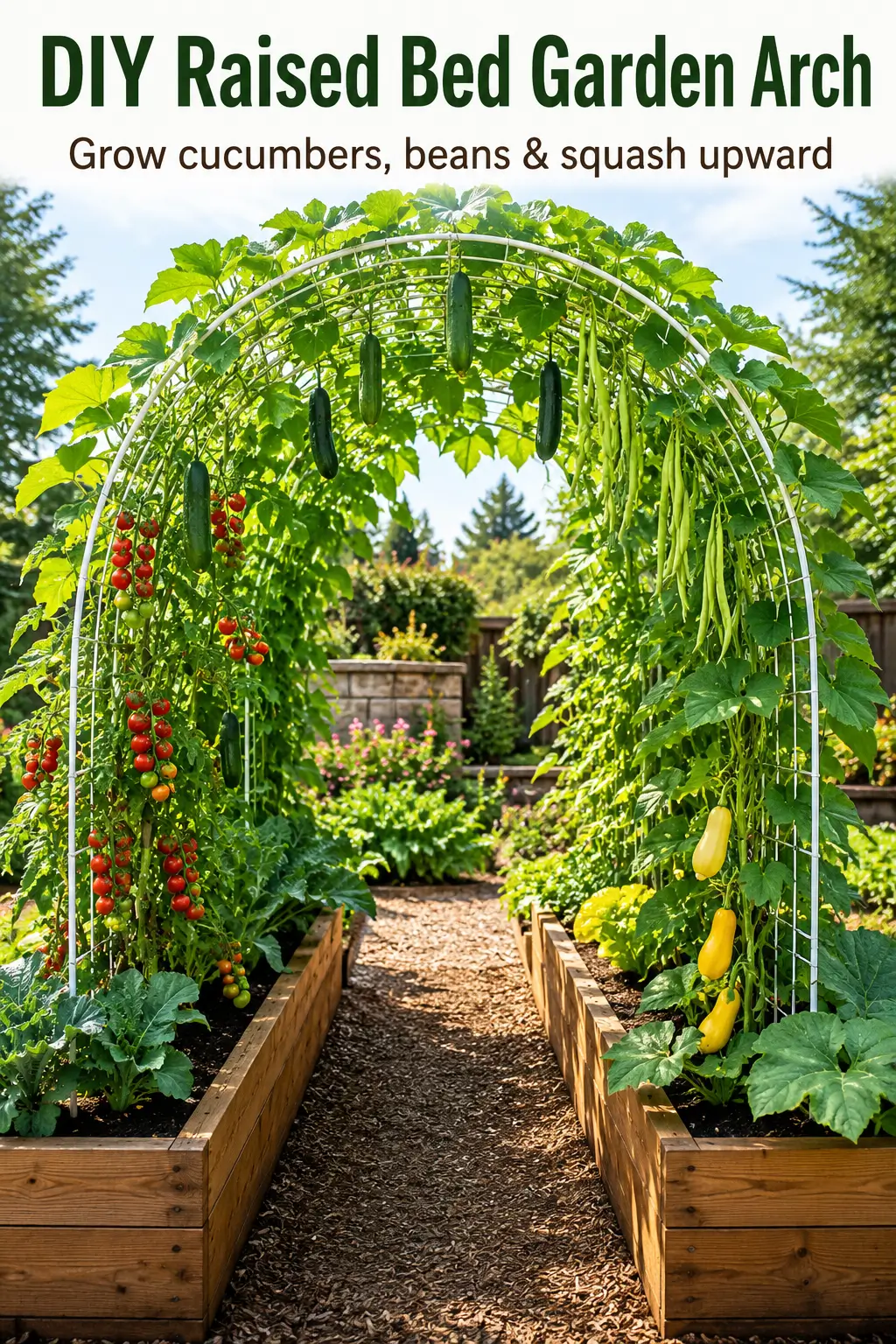
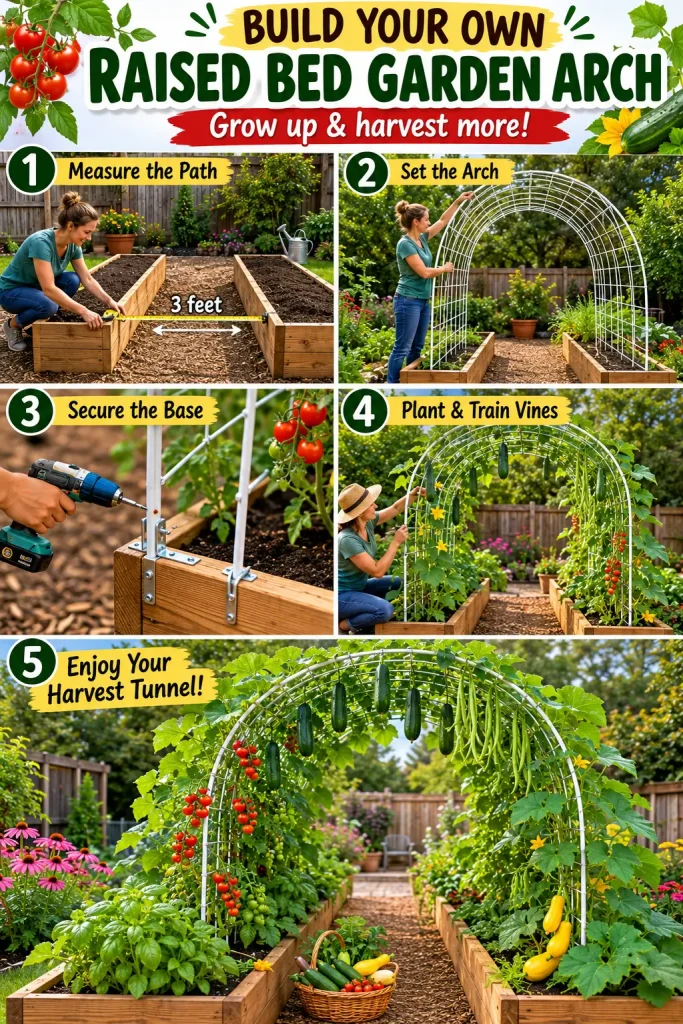
A raised bed garden arch is one of the smartest ways to grow climbing vegetables in a small backyard. Instead of letting cucumber vines, pole beans, small squash, and long tomato branches sprawl across the soil or block your garden path, you can train them upward over a simple arch between two raised beds.
This creates a beautiful “harvest tunnel” where the path stays open, vines grow vertically, and fruit becomes easier to see and pick. It also adds height and structure to the vegetable garden, making the space feel more organized and productive.
This idea works especially well between two raised beds with a walking path in the middle. The arch connects both sides and gives climbing crops a strong place to grow. With the right materials and proper support, it can turn a plain garden path into one of the most useful features in your backyard.
Why a Raised Bed Garden Arch Works
A raised bed arch works because it uses vertical space. Many vegetable gardens run out of room quickly because vining crops spread wide across the ground. Cucumbers, beans, and squash can take over paths, cover other plants, and make harvesting harder.
Growing them upward keeps the bed cleaner and more manageable. The vines climb along the arch instead of crawling across the soil. This can improve airflow around the plants, make pests easier to spot, and help reduce fruit sitting directly on damp ground.
It also makes harvesting easier. Cucumbers and beans often hang down through the arch, so you can see them clearly from the path. Instead of digging through tangled leaves, you can walk under or beside the arch and pick what is ready.
A garden arch also adds beauty. It creates a tunnel effect that makes a vegetable garden feel intentional, lush, and inviting.
Best Crops to Grow on a Raised Bed Arch
Not every vegetable should be grown on an arch, but many climbing and vining crops work well when supported correctly.
Cucumbers
Cucumbers are one of the best crops for a garden arch. They climb easily with tendrils and often hang neatly from the trellis. Choose vining cucumber varieties, not bush types, if you want them to climb well.
Pole Beans
Pole beans are excellent for arches because they naturally twine upward. They are lighter than squash and usually do not need extra slings or heavy support.
Small Squash
Small squash varieties can grow on a strong arch, but they need more care. Choose smaller fruits rather than large heavy squash. Heavier fruit may need fabric slings so the vines do not break.
Cherry Tomatoes
Tomatoes do not naturally climb like beans or cucumbers, but they can be tied to an arch or side trellis. This works best with indeterminate cherry tomatoes or smaller-fruited varieties. They need regular tying and pruning to stay controlled.
Peas
Sugar snap peas and shelling peas can grow beautifully on an arch in cooler seasons. They are lightweight and easy to train.
Small Melons
Some small melon varieties can grow on a strong arch, but the fruit must be supported with slings. Avoid trying this with large melons unless the structure is very strong.
What You Need
To build a simple raised bed arch, you will need:
- Two raised garden beds with a path between them
- Cattle panel, heavy-duty garden mesh, or strong metal arch panel
- Heavy-duty zip ties, galvanized wire, or U-shaped fence staples
- T-posts, wooden stakes, or rebar for extra support
- Work gloves
- Wire cutters, if trimming mesh
- Measuring tape
- Hammer or mallet
- Drill, optional
- Pruners
- Soft garden ties or twine
- Landscape staples, optional
- Fabric strips or mesh slings for heavier fruit
For a strong, long-lasting arch, a cattle panel is one of the best choices. It holds its shape well and can support heavier vines better than thin plastic netting.
Best Size for a Raised Bed Arch
A practical garden arch should be tall enough to walk under or reach through comfortably.
A good size is:
- Path width: 2 to 4 feet
- Arch height: about 6 to 7 feet at the center
- Raised bed height: 10 to 18 inches
- Arch length: 6 to 8 feet, depending on the panel size
If your path is narrow, the arch will be taller and more curved. If the path is wider, the arch will be lower and flatter.
Make sure the arch is not so low that it blocks the walking path once vines begin growing.
Best Placement or Setup
Place the arch between two raised beds with a clear path in the middle. The beds should receive at least 6 to 8 hours of sun per day for most fruiting vegetables.
The path should stay open enough for walking, watering, and harvesting. A 3-foot-wide path is comfortable for many home gardens.
Avoid placing the arch where it will shade sun-loving plants too heavily. Tall arches can cast shade, especially in the morning or late afternoon. Plant shade-tolerant crops or herbs nearby if needed.
For the best layout, plant climbing crops along the inside edge of each raised bed so they can grow directly onto the arch.
Step-by-Step Instructions
Step 1: Choose the Arch Material
Start with a strong trellis material. A cattle panel is ideal because it is sturdy, bendable, and long-lasting. Heavy-duty welded wire mesh can also work if it is strong enough.
Avoid thin plastic netting for heavy crops. It may sag, tear, or become tangled in vines.
If you only plan to grow peas or beans, lighter mesh may be enough. For cucumbers, tomatoes, small squash, or melons, choose a stronger structure.
Step 2: Measure the Path Between the Beds
Measure the space between your two raised beds. Most garden paths are 2 to 4 feet wide.
The arch should curve over the path without making the walkway too tight. You should be able to walk through the center and reach the plants from both sides.
If the path is very wide, you may need a longer panel or a stronger frame to keep the arch high enough.
Step 3: Bend the Panel Into an Arch
With help from another person, carefully bend the panel into an arch shape. Wear gloves because metal edges can be sharp.
Place one end of the panel inside or along the edge of one raised bed, then curve the other end toward the opposite bed.
The arch should look smooth and even, not twisted. Take your time adjusting it before securing it.
Step 4: Secure the Base
Secure each side of the arch firmly to the raised beds or to support stakes.
You can attach the panel to wooden raised beds using U-shaped fence staples or heavy-duty screws with washers. If your beds are not wood, drive T-posts, rebar, or strong stakes into the ground beside each bed and tie the panel to them.
The base must be strong because vines become heavy when mature, especially after rain or when fruit is hanging.
Step 5: Add Extra Support for Heavy Crops
If you plan to grow small squash, tomatoes, or melons, add extra support.
Drive T-posts or sturdy stakes at each corner of the arch and secure the panel to them with galvanized wire or heavy-duty zip ties.
For heavier fruit, prepare fabric slings. You can make slings from old cotton cloth, soft mesh, or strips of garden fabric. Tie each sling to the arch so the fruit can rest inside without pulling on the vine.
Step 6: Prepare the Soil
Before planting, fill the raised beds with rich, well-draining soil. Mix in compost or aged organic matter.
Climbing vegetables need steady nutrition and moisture. Cucumbers, squash, beans, and tomatoes all grow best in healthy soil with enough organic matter.
Avoid compacted soil around the roots. Raised beds should drain well but still hold enough moisture for summer crops.
Step 7: Plant Along the Inside Edge
Plant climbing crops near the base of the arch, along the inside edge of each raised bed.
General spacing:
- Cucumbers: 12 to 18 inches apart
- Pole beans: 6 to 8 inches apart
- Peas: 2 to 4 inches apart
- Cherry tomatoes: 18 to 24 inches apart
- Small squash: 24 to 36 inches apart
- Small melons: 24 to 36 inches apart
Do not overcrowd the arch. A few strong plants are better than too many tangled vines.
Step 8: Train the Vines Early
As the plants grow, gently guide them toward the arch.
Cucumbers, peas, and beans will often grab the trellis on their own. Tomatoes and squash may need soft ties to hold them in place.
Use soft garden ties, twine, or plant clips. Do not tie stems tightly because they need room to grow thicker.
Check the vines every few days during fast growth. It is much easier to train young vines than to fix a tangled mess later.
Step 9: Keep the Path Open
As the arch fills in, trim or tie back growth that hangs too low into the walkway.
The goal is to create a harvest tunnel, not a blocked path. Keep enough space to walk through, water plants, and pick fruit.
If vines become too thick, remove a few older leaves to improve airflow. Do not remove too much at once, especially in hot weather, because leaves protect fruit from sunscald.
Step 10: Harvest Often
Harvest cucumbers, beans, peas, and squash regularly. Frequent harvesting encourages many plants to keep producing.
Do not let heavy fruit hang too long. Pick cucumbers before they become oversized, and support squash or melons as soon as they begin gaining weight.
Check both sides of the arch and look underneath leaves. A garden arch makes fruit easier to see, but vines can still hide produce.
Care Tips
Water the raised beds deeply and consistently. Vining crops can dry out quickly in hot weather, especially when growing vertically.
Water at the soil level instead of spraying leaves. This helps keep foliage drier and may reduce disease pressure.
Mulch around the plants with straw, shredded leaves, or untreated grass clippings to help hold moisture and reduce weeds.
Feed heavy crops like cucumbers, tomatoes, squash, and melons with compost or a balanced garden fertilizer as needed. Beans and peas usually need less feeding because they are legumes.
Check ties often. As stems grow thicker, tight ties can cut into the plant. Loosen or replace ties when needed.
For tomatoes, prune lightly to keep vines manageable. For cucumbers and beans, guide vines instead of heavy pruning.
Common Mistakes to Avoid
Using Weak Netting
Thin netting may work for peas, but it is not strong enough for heavy cucumbers, squash, or tomatoes. Use cattle panel or sturdy welded wire for a lasting arch.
Not Securing the Arch Properly
A loose arch can shift, lean, or collapse when vines become heavy. Anchor the base firmly before planting.
Planting Too Many Crops
Overplanting creates tangled vines, poor airflow, and hidden fruit. Give each plant enough space to grow.
Growing Heavy Squash Without Slings
Small squash can still become heavy. Use slings when fruit begins to pull on the vine.
Letting Tomatoes Grow Without Ties
Tomatoes need support because they do not naturally cling to the arch. Tie them gently and check them often.
Blocking the Path
If vines hang too low, the path becomes hard to use. Train growth upward and trim only where needed.
Forgetting to Harvest
Overripe cucumbers, beans, and squash can slow production. Pick often to keep plants productive.
Best Design Ideas for a Raised Bed Arch
For a clean vegetable garden look, use two matching wooden raised beds with a gravel or mulch path between them. A white or galvanized metal arch gives a bright, organized look.
For a rustic garden, use natural wood raised beds and a cattle panel arch. Let beans, cucumbers, and flowering vines grow together for a lush harvest tunnel.
For small gardens, use one short arch between two narrow beds. Grow peas in spring, cucumbers in summer, and pole beans later in the season.
For a colorful edible garden, combine cherry tomatoes, purple pole beans, yellow cucumbers, and nasturtiums along the edges.
Just be careful not to mix too many aggressive vines on one arch. Keep the planting simple enough to manage.
FAQ
What vegetables grow best on a garden arch?
Cucumbers, pole beans, peas, small squash, cherry tomatoes, and small melons can grow on a garden arch. Cucumbers, beans, and peas are usually the easiest choices.
Can tomatoes grow on an arch?
Yes, tomatoes can grow along an arch, but they need to be tied because they do not naturally climb. Indeterminate cherry tomatoes work best.
Can cucumbers grow over an arch?
Yes, cucumbers are excellent for arches. Choose vining cucumber varieties and train the young vines onto the support.
How wide should the path be under a garden arch?
A path between 2 and 4 feet wide works well. Around 3 feet is comfortable for walking, watering, and harvesting.
Do squash need support on an arch?
Small squash can grow on a strong arch, but heavier fruits may need fabric slings. Large squash varieties are usually better grown on the ground or on very strong supports.
What is the best material for a vegetable garden arch?
Cattle panel is one of the best materials because it is strong, bendable, and long-lasting. Heavy-duty welded wire can also work.
How do I keep the arch from falling over?
Anchor the arch firmly to raised beds, T-posts, rebar, or strong stakes. Secure it before planting because the vines will get heavier as they grow.
Can I use this arch in a small garden?
Yes. A raised bed arch is great for small gardens because it uses vertical space and keeps vines off the path.
Conclusion
A raised bed garden arch is a practical and beautiful way to grow more food in less space. It turns the path between two beds into a harvest tunnel where cucumbers, beans, peas, tomatoes, and small squash can grow upward instead of spreading across the ground.
The key is using a strong arch, anchoring it well, spacing plants correctly, and supporting heavier fruit when needed.
With the right setup, your garden path stays open, your crops are easier to harvest, and your raised beds become a lush, organized, productive backyard feature.